
What Most Tournament Directors Don’t Know About Youth Sports Verification
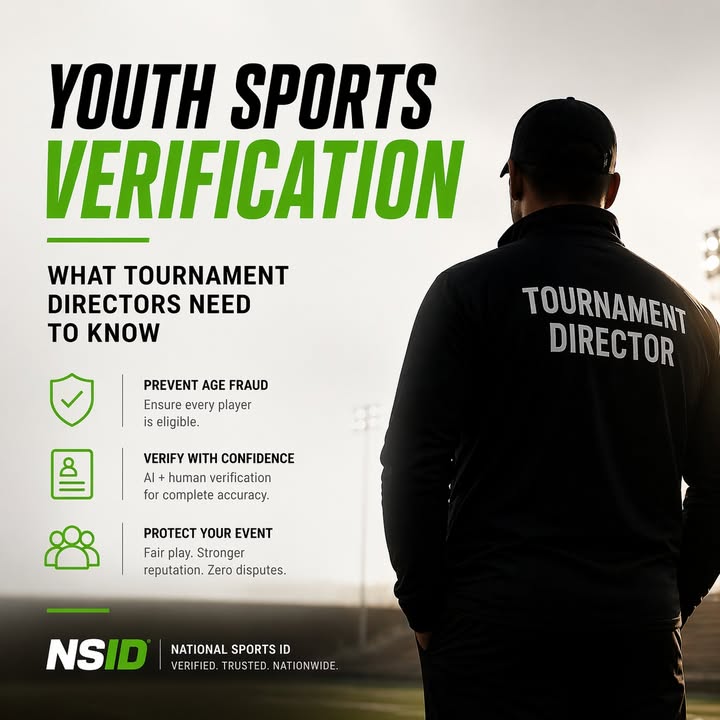
You have probably already got a platform. Maybe it is the one your governing body recommended. Maybe it is the one everyone in your region uses. Maybe someone told you there is a free option that handles scheduling just as well as anything else on the market.
There is no shortage of platforms competing for your attention in the youth sports management space. Registration tools. Communication apps. Compliance dashboards. Scheduling engines. The options keep multiplying.
But here is what most tournament directors do not realize until it is too late:
Most of these platforms were not built to solve your biggest problem.
Age fraud. Eligibility disputes. Ineligible players competing in the wrong division. A parent protest that halts your bracket on Day 2.
If you are running a competitive youth sports event, verification is not a feature you need. It is the foundation everything else is built on. And when you look closely at what is actually available, the differences between platforms are not subtle. They are significant.
The Problem No One Talks About Until It Happens to Them
If you have directed tournaments long enough, you have seen it. A team that looks a little too old for 10U. A coach who cannot produce credentials when asked. A player whose birth certificate mysteriously cannot be found on game day.
Age fraud in youth sports is not a rare exception. It is a persistent problem that thrives wherever verification is manual, inconsistent, or simply nonexistent.
And the consequences reach further than fairness. They touch your reputation, your organization’s liability, and the experience you promised to hundreds of families who showed up and paid to compete.
The right question is: “Was this platform actually built to solve that problem?”
For most tools in this space, the answer is no.
The Platforms Most Leagues Are Using — And What They’re Actually Built For
The Media and Management Giants
Some of the most recognized names in youth sports technology were built by media companies and tech investors looking to capture a growing market. They are broad platforms built around registration, scheduling, website management, and communication, and they often do those things reasonably well.
Verification, when it exists at all, is usually an add-on module layered onto a platform that was not designed around it. There is no AI-assisted document review. No photo-verified rosters. And the customer support tournament directors depend on in high-pressure moments can be slow when something goes wrong.
A broad scheduling platform may be powerful, but powerful general tools and purpose-built verification are two very different products. When an eligibility crisis hits at 7 a.m. on a Saturday, that difference becomes impossible to ignore.
The Communication Apps
Other platforms built their reputation on team communication — scheduling, parent notifications, RSVP tracking, and calendar sync. Coaches like them. Parents use them daily. They solve the coordination problem well.
But they do not solve eligibility.
There is no age verification. No document review. No way to confirm that the player stepping onto your field belongs in that age division. That capability simply does not exist in the product, because it was never the point.
When families are organized and communication is strong, these tools shine. But they cannot tell you whether your event is being played fairly.
The Compliance Bolt-Ons
A newer category of platform has emerged around safety and compliance. These tools often handle background checks, coach certifications, SafeSport training, and role-based requirement tracking for volunteers and staff.
That is valuable work. But adult compliance and player eligibility verification are two different problems.
Making sure every coach is properly credentialed matters. So does making sure every player on the roster is the correct age for the division. These are not the same workflow, and platforms built around one do not automatically solve the other.
Many compliance-focused tools also require a separate registration platform to function, which means more integrations, more contracts, and more points of failure.
The Free Options
Free is always appealing, especially for organizations managing budgets carefully. Some free platforms have built useful scheduling and bracket tools with strong adoption.
The trade-off shows up in reliability. When registration loops parents in circles, verification emails fail to send, or families cannot complete waivers before the event, the cost of “free” becomes very real.
Limited support, inconsistent performance under pressure, and verification processes without an AI layer or human review create risks that do not show up in the price tag.
For a low-stakes recreational league, a free tool may be enough. For a competitive tournament where your credibility is on the line, reliability is not optional.
What NSID Was Actually Built to Do
National Sports ID was not created by developers looking for a market to enter. It was founded by youth sports event organizers who had lived through these problems personally — the binders of birth certificates, the sideline protests, the frustrated families, and the last-minute eligibility disputes that no one was prepared to resolve.
That origin matters. Every feature NSID offers exists because someone who ran tournaments decided it needed to exist.
- AI + Human Verification: NSID combines AI-assisted document review with trained human analysts to catch fraud that automated-only systems can miss.
- Photo Verified Rosters: Verified team rosters with player photos make game-day check-in faster and help deter player swapping.
- Documents Deleted After Verification: Submitted documents are permanently deleted after verification is complete.
- 1 Million+ Players Verified: NSID has a proven track record across 20,000+ events and 150,000+ verified coaches nationwide.
- 24/7 Live Support: Because eligibility issues do not wait for business hours.
- All-in-One Platform: Registration, verification, scheduling, waivers, roster management, and payments in one system.
The Question Worth Asking Before Your Next Event
Most tournament directors do not switch platforms after a smooth event. They switch after a disaster — after the eligibility protest that derailed their bracket, after the ineligible player who competed all weekend, or after the parent who showed up with no documentation and a very loud voice.
The verification platform you choose is not just a software decision. It is a statement about what your event stands for and how seriously you take the integrity of competition.
When you evaluate your options honestly, the differences come down to one thing: purpose.
Some platforms were built for sports management. Others for communication. Others for adult compliance. Others to be free.
Ready to See NSID in Action?
Learn how leading tournaments across the country are running cleaner, faster, and dispute-free events with one verification-first platform.
Schedule a Demo