
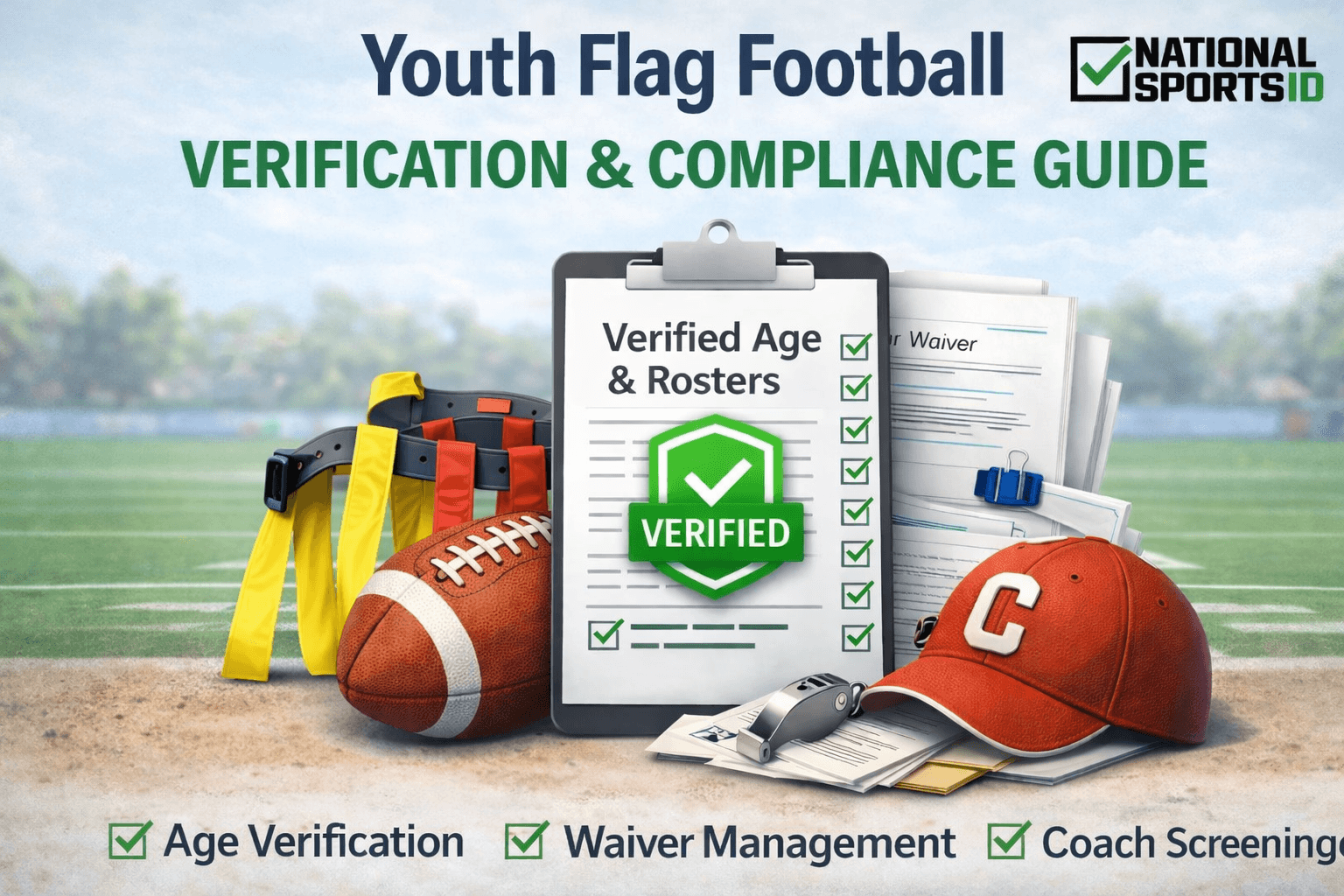
Youth Flag Football Verification & Compliance Guide
Introduction
Youth flag football is one of the fastest-growing sports in the United States, with participation expanding rapidly across recreational leagues, NFL FLAG programs, and school-based organizations.
Most programs are run by a single volunteer coordinator managing registration, waivers, rosters, and coach assignments — often with limited time and minimal administrative support. As programs grow from dozens to hundreds of players, manual systems quickly break down.
This guide covers the key verification and compliance challenges facing flag football organizations, including age verification, waiver management, coach screening, division structure, and data privacy requirements.
Request a Demo or Get Started with NSID → Book a Demo
The Flag Football Compliance Landscape
- Flag football participation has grown to over 7 million athletes nationwide
- Programs often scale rapidly from small groups to hundreds of players within one season
- Most leagues are operated by volunteer coordinators with limited administrative time
- School-based programs must meet FERPA and student data privacy requirements
- Olympic inclusion is increasing pressure for formalized compliance processes
- Paper-based systems cannot support large-scale participant management
As flag football continues to expand, organizations need systems that can handle growth while maintaining compliance, safety, and operational efficiency.
Flag Football Eligibility Challenges & Solutions
1. One Volunteer Managing Hundreds of Players
Many flag football programs are run by a single coordinator responsible for collecting documents, managing rosters, and organizing teams. As participation grows, this becomes unsustainable.
Impact: Missing waivers, incomplete registrations, unverified players, and administrative burnout.
Solution: A parent self-service system allows families to upload documents, complete waivers, and manage requirements without coordinator involvement.
2. Program Growth That Breaks Manual Systems
Flag football programs often grow from 50 to 500+ players in a single season. Paper systems and spreadsheets cannot scale at that level.
Impact: Lost records, inconsistent divisions, unverified participants, and compliance failures.
Solution: Digital systems scale automatically, handling large volumes of participants without additional administrative burden.
3. School-Based FERPA Compliance Requirements
Flag football programs in schools must comply with federal student data protection laws such as FERPA. Many traditional systems are not built for this level of compliance.
Impact: Legal risk, program shutdowns, and restricted facility access.
Solution: Secure data handling, encryption, and controlled access to participant information.
4. Co-Ed and Division Structure Complexity
Flag football frequently includes co-ed and gender-specific divisions. Without clearly defined rules, placement disputes become common.
Impact: Parent complaints, player attrition, and inconsistent competition.
Solution: Clearly defined eligibility rules applied consistently through registration systems.
5. Unverified Coaches in Open-Entry Programs
Flag football allows anyone to start a team, often without a structured coach verification process.
Impact: Safety concerns, liability exposure, and reputational risk.
Solution: Coach verification and background screening before participation is approved.
How NSID Supports Flag Football Compliance
- Age and grade verification using AI-assisted review with human oversight
- Coach identity verification and background screening
- Digital waiver collection and tracking
- Verified roster generation with player photos
- Pre-event verification to eliminate check-in delays
- Integrated scheduling and communication tools
This allows flag football organizations to reduce administrative workload while improving compliance and organization.
How the Process Works
1. Set Requirements
Define verification requirements such as age, waivers, and coach credentials.
2. Families Submit Information
Parents and coaches upload documents through a mobile-friendly system.
3. Verification Happens
Documents are reviewed and verified before the event.
4. Run Your Event
Players arrive verified, reducing delays and improving organization.
Without Verification vs. With Verified Systems
Without Verification
✅
With Verified Systems
Paper waivers collected at check-in
→
✅
Digital waivers completed in advance
Manual document review
→
✅
Verified documents before arrival
Long check-in lines
→
✅
Fast event entry
No audit trail
→
✅
Time-stamped records
Coaches assumed verified
→
✅
Verified and screened coaches
Best Practices for Flag Football Organizations
- Start verification at registration
- Define division rules clearly before sign-ups
- Require coach verification
- Use digital waivers for all participants
- Review compliance status before game day
Data Security & Privacy
- Secure data handling and encrypted systems
- Documents processed for verification and not unnecessarily stored
- Controlled access to participant data
- Compliance with youth data protection standards
Youth Flag Football Verification & Compliance FAQs
How does youth flag football verification work?
Youth flag football verification confirms player eligibility using official documents such as birth certificates or school records before participation.
Do flag football leagues require age verification?
Yes, most leagues require age verification to ensure players are placed in the correct divisions.
Why are waivers important in flag football?
Waivers provide legal protection and confirm parent consent before participation.
How do flag football leagues manage large numbers of players?
Digital systems help automate registration, verification, and communication to manage scale.
Do flag football coaches need verification?
Yes, coach verification helps ensure safety and compliance within youth programs.