
Youth Volleyball Verification & Compliance Guide
Introduction
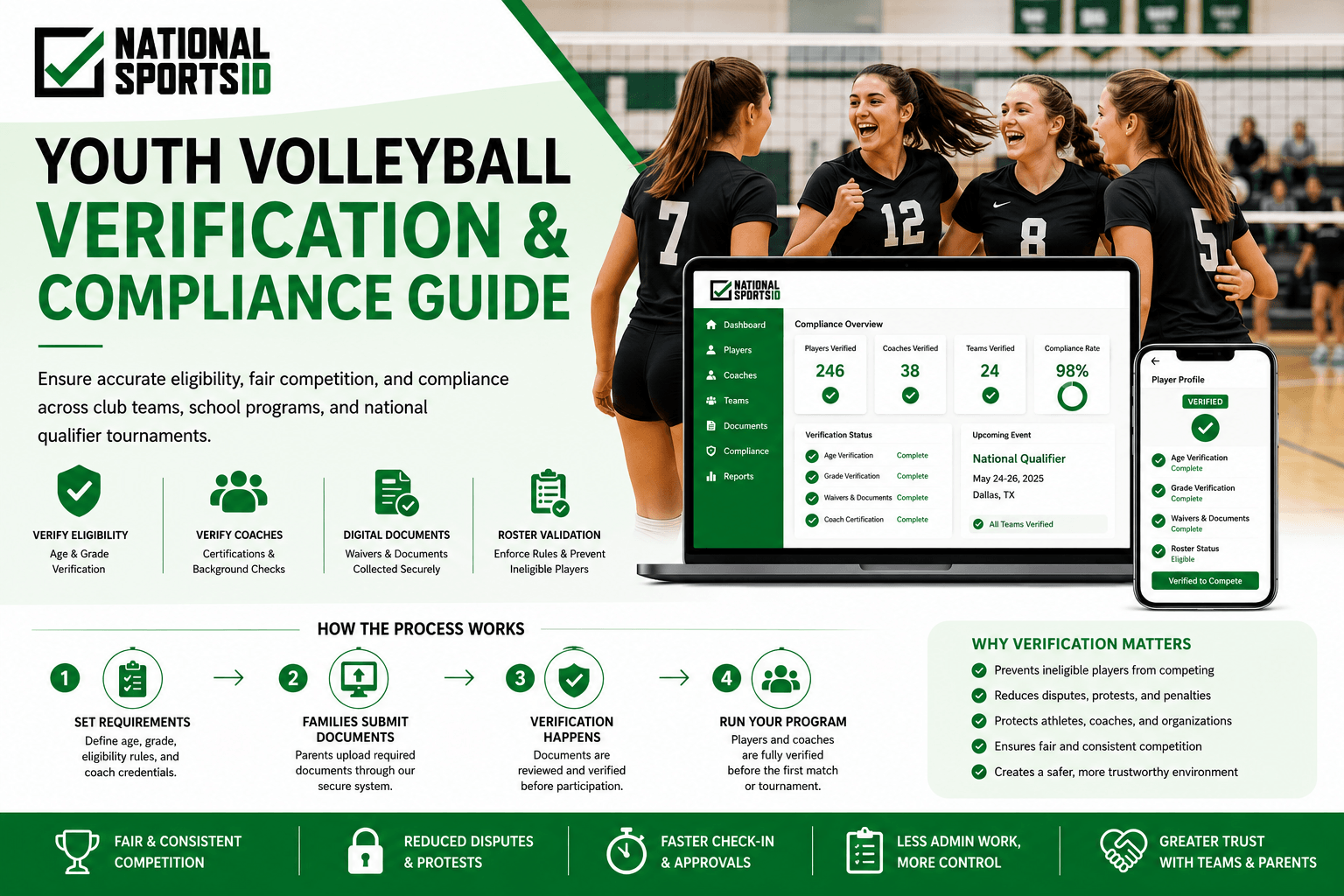
Youth volleyball verification is essential for ensuring accurate eligibility, fair competition, and compliance across club teams, school programs, and national qualifier tournaments.
Volleyball is one of the largest and fastest-growing youth sports in the United States, with hundreds of thousands of athletes competing across USA Volleyball, AAU, JVA, and independent club circuits. With so many overlapping governing bodies, eligibility rules and verification standards vary widely — and membership cards often confirm only dues payment, not verified age or grade.
This guide outlines the key verification challenges in youth volleyball and how organizations can implement systems to verify age, grade, and eligibility across all levels of competition.
Request a Demo or Get Started with NSID → Book a Demo
The Volleyball Compliance Landscape
- Governing body membership cards confirm payment, not verified eligibility.
- Age-based club divisions and grade-based school divisions create mismatches.
- Academic reclassification for height and skill advantages is increasing in club volleyball.
- Dual participation between club and school programs causes rule violations.
- Multi-team rostering across club programs creates eligibility conflicts.
- Manual systems fail to track these requirements consistently.
With USA Volleyball, AAU, JVA, and independent club circuits all operating in parallel, eligibility rules and verification standards vary widely — leaving tournament directors and program leaders to manually resolve disputes with limited documentation.
Volleyball Eligibility & Verification Challenges
1. Governing Body Cards Do Not Verify Eligibility
Membership cards from USA Volleyball, AAU, and similar organizations only confirm dues payment and provide no verified age, grade, or eligibility data.
Impact: Disputes, protests, and lack of enforceable eligibility standards at tournaments and qualifiers.
Solution: Verification using official documents rather than membership cards.
2. Age vs. Grade Division Conflicts
Club volleyball uses age-based divisions (12U, 14U, 16U, 18U) while school volleyball uses grade-based divisions, creating mismatches when athletes cross between systems.
Impact: Confusion, unfair matchups, and administrative burden for tournament directors.
Solution: Dual verification of age and grade for every player.
3. Academic Reclassification
Players repeating a grade gain physical and developmental advantages in younger divisions — a growing concern in competitive club volleyball.
Impact: Competitive imbalance, recruiting distortion, and unfair height or skill mismatches.
Solution: Cross-checking age and grade to identify discrepancies.
4. Club vs. School Participation Violations
Players participating in both club and school programs may violate season overlap rules or state association eligibility requirements without realizing it.
Impact: Suspensions, forfeited matches, and lost scholarship opportunities.
Solution: Tracking affiliations and participation history across programs.
5. Coach Certification Gaps
New club programs often lack proper coach certification, SafeSport compliance, and background screening — particularly at the developmental level and with assistant coaches.
Impact: Safety risks and liability exposure for organizations and parents.
Solution: Verification of all coaches, not just head coaches.
How NSID Supports Volleyball Compliance
- Age and grade verification with AI-assisted review
- Verified player profiles accessible across events and programs
- Coach verification including certifications and background checks
- Digital waiver and document collection
- Roster validation to enforce eligibility rules
- Verified roster generation before tournament play
Learn more about youth sports coach verification and background check software.
How the Process Works
1. Set Requirements
Define verification needs, including age, grade, eligibility rules, and coach credentials.
2. Families Submit Documents
Parents upload required documents through a mobile-friendly system.
3. Verification Happens
Documents are reviewed and verified before participation.
4. Run Your Program
Players and coaches are fully verified before the first match or tournament.
Without Verification vs. With Verified Systems
Without Verification
✅
With Verified Systems
Membership cards used as eligibility
→
✅
Verified player profiles
Age and grade checked manually
→
✅
Dual verification automated
Reclassification undetected
→
✅
Cross-checked and flagged
Coaches assumed certified
→
✅
Verified and credentialed coaches
No audit trail
→
✅
Complete compliance records
Best Practices for Volleyball Organizations
- Verify both age and grade for every player
- Do not rely on governing body cards for eligibility
- Require certification for all coaches, including assistants
- Track dual participation between school and club programs
- Digitize all compliance and documentation processes
Data Security & Privacy
- Secure data storage with encryption
- Documents processed and not unnecessarily retained
- Controlled access to sensitive data
- No biometric data collection
Digital compliance systems help volleyball organizations securely manage eligibility data while reducing reliance on paper records and manual tracking.
Youth Volleyball Verification & Compliance FAQs
How does youth volleyball verification work?
Verification confirms age, grade, eligibility, waivers, and coach certification before participation in club, school, or tournament play.
Why are governing body cards not enough?
They confirm dues payment, not verified eligibility information such as age or grade.
What is reclassification in youth volleyball?
It is when a player repeats a grade to compete against younger athletes for a developmental or physical advantage.
What documents are required for youth volleyball?
Common documents include proof of age, school records confirming grade level, signed waivers, and coach certification records.
Do all coaches need certification?
Yes, all head coaches, assistants, and volunteers should meet safety and certification requirements.